
Affordable health care is at the center of the Economic Opportunity Institute’s work because we know we cannot build a secure economy without it. As the cost of health care is increasingly shifted onto workers and families through higher premiums and out-of-pocket costs, while mega health care giants rake in the profits, we need to take a multi-pronged approach to improve health care access for all Washingtonians.
The problem
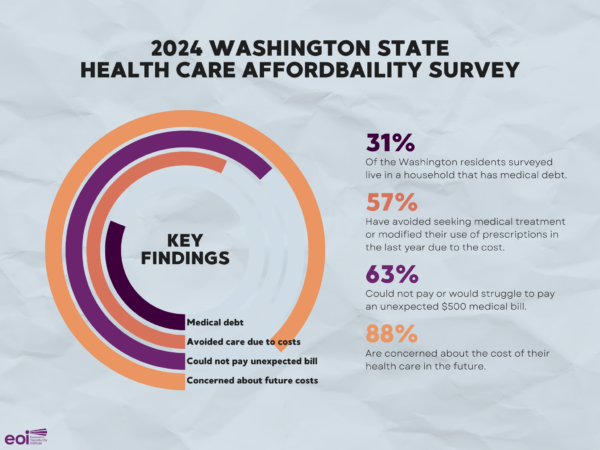
The rising cost of health care is unsustainable and out of control. Patients are forced to choose between going to the doctor and paying for other essential needs like food and rent. Health insurance premiums for individuals and small businesses increased by approximately 10%(opens in new tab) for three years running, rising far faster than wages or inflation.(opens in new tab) More than half of Washingtonians recently surveyed(opens in new tab) said they had skipped or delayed getting the care they needed because of cost. And yet, we know this is a top priority for Washingtonians: The same survey showed that 87% of respondents across political parties agree that elected officials in Washington need to take action on health care affordability.
Our solutions
EOI’s 2025 health care legislative agenda includes policies that push for both immediate support for families as well as longer term and upstream solutions with the Fair Health Prices(opens in new tab) agenda. Fair Health Prices is a campaign that EOI co-founded with community partners to drive down the price of care and work shoulder-to-shoulder with patient advocates, labor unions, and small business owners. The Fair Health Prices agenda includes priorities to tackle high prices, slow corporate influence, improve transparency, and stop unfair medical billing.
Immediate support
- Cascade Care Savings program subsidies have helped thousands in Washington access more affordable care. But we are at risk of losing ground on our progress in the face of the state legislative revenue shortfall and uncertain federal landscape. In Washington, 227,000 Washingtonians are likely to lose direct premium and cost sharing assistance if the federal government fails to extend federal premium tax credits. We must maintain our state premium assistance at $55 million per year and expand funding to safeguard Washingtonians against federal attacks.
- Everyone deserves access to quality, affordable health care — regardless of where you were born or how much money you make. The Washington State Legislature has taken meaningful steps in recent years to advance equity in health care access for all, regardless of immigration status. This bill (House Bill 1482(opens in new tab)) would bring critical funding to ensure all low-income Washingtonians have access to life-saving medical care, regardless of immigration status.
Tackle high prices
- House Bill 1123(opens in new tab)/Senate Bill 5083(opens in new tab) will moderate and rebalance prices through “reference pricing.” This Health Care Authority (HCA) request bill uses a proven model to set reasonable payment limits in public and school employee health plans for hospitals (at two times the Medicare rate plus more for rural, community, and children’s hospitals) and adds minimum payment levels for primary care and behavioral health (at 1.5 times the Medicare rate). Patient costs will be lower, and the state will save ~$400M.
Learn more about supports for public and school employees.(opens in new tab)
Slow corporate influence
- House Bill 1881(opens in new tab)/Senate Bill 5704(opens in new tab) will enhance state oversight of health system consolidation, allowing the attorney general to review proposed mergers and acquisitions to ensure the transaction would promote equitable access to services and patient affordability.
- Senate Bill 5387(opens in new tab)/House Bill 1675(opens in new tab) will codify Corporate Practice of Medicine protections to keep patient health decisions in the hands of licensed clinicians rather than outside business interests.
- House Bill 1560(opens in new tab)/Senate Bill 5638(opens in new tab) will tax excess compensation of hospital executives, returning funds to the public if executives pay themselves more than 10 times Washington’s average wage (~$900,000).
Improve transparency
- Senate Bill 5493(opens in new tab) will require hospitals to publish their prices for certain services, giving the Department of Health new authority to enforce federal price transparency rules. Hospitals that fail to publish their prices can’t collect on medical debts for those services.
- House Bill 1382(opens in new tab) will increase public transparency in our state’s All Payer Claims Database by prohibiting insurers or providers from withholding health care prices by claiming the information is “proprietary.” This HCA-request bill will also allow public purchasers like the state to use claims data to help make better health care purchasing decisions.
- Senate Bill 5561(opens in new tab)/House Bill 1686(opens in new tab) will help solve a critical infrastructure gap by creating a registry of health care providers, organizations, and facilities. This bill will improve health care resource planning, allowing us to analyze provider shortage areas that impact rural areas or other underserved communities and monitor trends in consolidation.
Stop unfair medical billing
- Senate Bill 5480(opens in new tab)/House Bill 1632(opens in new tab) stops medical debt from being reported on consumer credit scores and gives patients and the attorney general the ability to sue under the Consumer Protection Act if debt collectors or hospitals/providers violate these protections.
- Senate Bill 5651(opens in new tab)/House Bill 1686(opens in new tab) helps prevent families from falling into poverty because of medical debt by ensuring a basic amount of family savings is protected from wage garnishment.
No one policy solution will fix our broken health care system. But together, these solutions will help keep our health care system working for those it was created for: the patients.
Stay up to date with EOI’s full 2025 legislative agenda.(opens in new tab)