
A millionaires tax is the first step towards achieving a progressive tax code that generates revenue for the infrastructure Washingtonians rely on for an affordable and meaningful life: high-quality public education, ample child care, affordable health care, and more housing options for families.
EOI supports a progressive tax code that does not require the poorest among us to pay the highest share of taxes. Right now, the lowest-income 20% of households in Washington pay 13.8% of their income in state and local taxes, and the middle 20% of households pay 10.9%, while the wealthiest 1% of households pay 4.1%. A millionaires tax would help take the pressure off of the majority of Washingtonians — nearly a third of whom cannot currently meet their basic needs — by increasing access to cost-reducing programs like Working Connections Child Care, decreasing taxes for low-income earners by expanding the Working Families Tax Credit, and exempting sales tax on basic needs items.
Washingtonians across the state are ready for a balanced tax code: 64% of voters upheld a capital gains tax on the ultra-wealthy, and 71% of Seattle voters approved a progressive fix to the city’s business and occupation tax structure that will provide meaningful relief to small businesses.
What gets taxed?
While SB 6346(opens in new tab)/HB 2724(opens in new tab) have not yet been passed by the legislature, the proposed Millionaires Tax is a 9.9% tax “on the receipt of Washington taxable income” with a deduction of $1 million per year. For example: If a household earns $1,000,100 in 2028, they would owe $9.90 in taxes. The Millionaires Tax would take effect on January 1, 2028. This means that the first tax returns and payments for 2028 taxable income will be due in April 2029.
According to 2022 IRS data(opens in new tab), there are only 21,530 households in Washington state that report over $1 million in annual income — 99% of Washingtonian households will not pay this tax. On average, households in this income bracket make an estimated $3 million per year.
The Millionaires Tax applies just to Washington state income, not financial assets or net worth. Additionally, no income already taxed is double-taxed under the current bill. If someone has pass-through or capital gains income, those count towards Washington state taxable income, but taxes already paid are credited from the owed millionaires tax. For example: If someone paid $15,000 in the Washington state capital gains tax and owed $20,000 in the MT, the $15,000 already paid would be deducted for a new total tax owed of $5,000. This is also true for business and occupation taxes that are already paid.
What about home and real estate value?
The sale of a home is not taxable. The sale of real estate and qualified family-owned small businesses are explicitly exempted from taxable income. The sale of real estate is also exempted in the Washington state definition of long-term capital gains.
Is the proposed tax constitutional?
Constitutional interpretation is ultimately determined by the Washington State Supreme Court.
Currently, the Washington State Constitution does not outright prohibit an income tax. The issue at stake is the precedent for interpreting income as property. Property is beholden to a uniformity clause, meaning all property taxes must be applied at the same rate within a given class of property. In Washington state, that rate is 1%. With income being classified as property, our state legislature cannot tax income at a rate above 1%; therefore, Washington state is prevented from having an equitable tax code. Washington is one of the only states that classifies income as property. This classification was initiated before the widespread adoption of income taxes.
To enact a Millionaires Tax at a rate higher than 1%, the court would need to overturn the definition of income as property; this is ultimately up to them. If kept the same, the current uniformity restriction leaves the lowest-income earners paying the greatest share of their income.
Won’t the rich just leave?
Millionaires move less than the wider public. Family, business, and social networks often keep them in place, along with access to local amenities. Washington state has many attractive qualities that keep people here: our sports teams, access to quality skiing and gorgeous hiking trails, fresh and well-prepared food, ample water (the ocean, the Sound, lakes), and so much more.
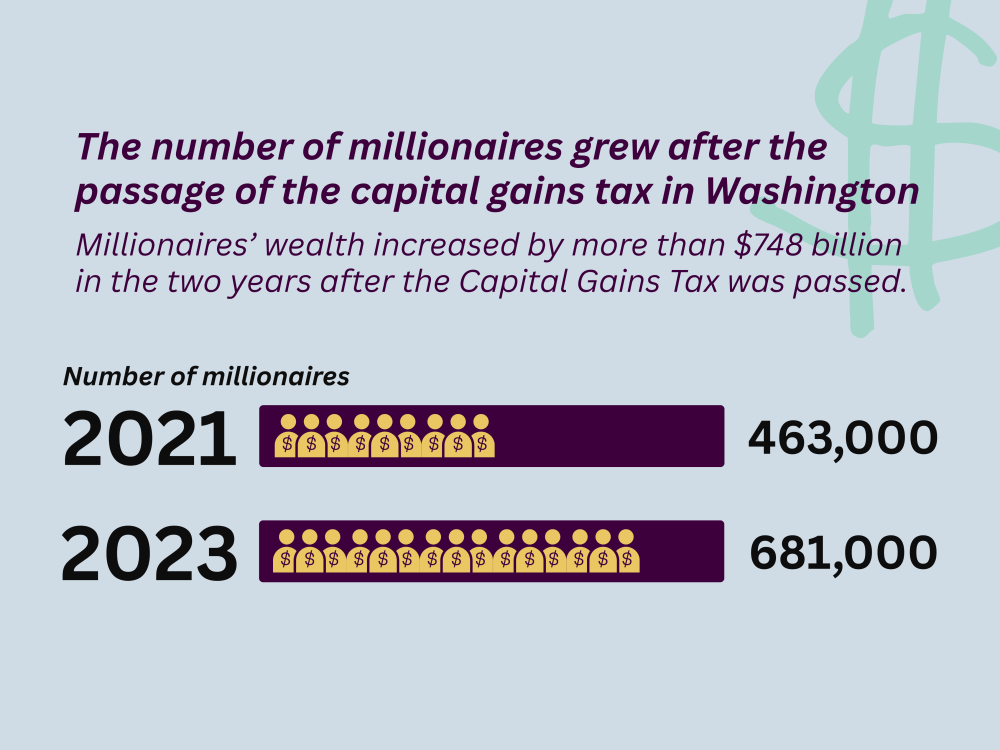
Tax policy does not usually compel the majority of millionaires to move out of state, nor does it significantly disrupt the accumulation of excess wealth. There were more than 463,000 millionaires in Washington in 2021, the year a capital gains tax was introduced. Two years later, there were over 681,000 millionaires with a wealth increase of more than $748 billion. Additionally, 41 other states tax individual earnings over $1 million per year, the options for regressive tax avoidance are slim and getting slimmer.
Unfortunately, it’s often people with low and middle incomes who are forced to make difficult decisions about moving for access to cheaper housing or for family support with child care.
How much revenue will this bring in and for how long?
The amount of revenue generated will depend on the tax rate determined by the legislature. However, yearly estimates for revenue from a 9.9% marginal tax rate on earnings above $1 million are between $3 and $4 billion. The governor has stated that if the legislature passes the millionaire tax this session, Washington could begin collecting revenue in 2029.
While the determination of how to spend the revenue generated from the Millionaires Tax is still being deliberated, the bill includes 95% of the revenue going to the State General Fund and 5% going to a newly created County Public Defense Funding Stabilization Account. The State General Fund spending will include an age expansion for the Working Families Tax Credit (to all people over 18 years of age), a sales tax exemption for grooming and hygiene products, a doubling of the Business and Occupation (B&O) tax exemption, and an early repeal of a B&O surcharge on high-grossing businesses.
Washington is an expensive place to live. We face some of the highest child care, housing, and transportation costs in the country, yet wages have not kept pace. Even though most Washingtonians work full time, nearly one-third cannot meet their basic needs on earnings alone — evidence of a deep and growing affordability crisis.
A millionaires tax would help address this gap by generating equitable revenue to fund cost-reducing and income-boosting programs that benefit everyone. Revenue would support affordable child care, sales-tax exemptions on essentials, an expanded Working Families Tax Credit, and strong public schools. States across the country are taking similar steps to confront rising costs — and Washington can too.