Middle- and low-income families are struggling to get by in this economy – and few are feeling the pain like students and their families(opens in new tab), according to a new report by D?mos. The culprit: states are shifting costs for higher education to students and families – and sadly, Washington state is a perfect example.
From 1990-2010, Washington’s population of 18-24 year-olds increased(opens in new tab) 33%. Enrollment(opens in new tab) shot up 84% at 4-year public universities and 16% at 2-year colleges. State funding didn’t just fail to keep up(opens in new tab) – it actually declined 29% for full-time students (from $8,635 in 1990 to $6,170 in 2010).
Years of steep tuition increases – and multiple(opens in new tab) rounds(opens in new tab) of program cuts(opens in new tab) – followed, with cost increases far outpacing household income (which were nearly flat over the same period).
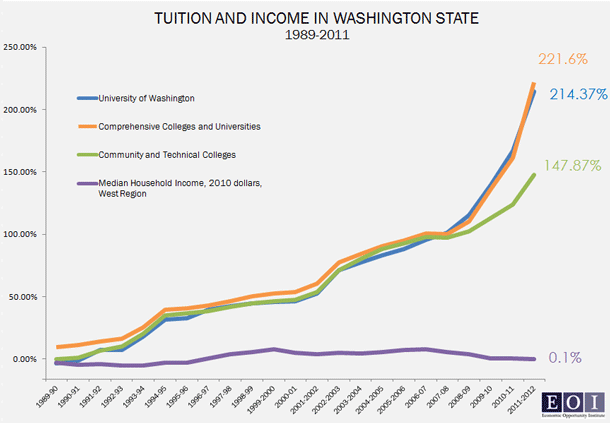
Higher costs mean students are taking on more debt to pay for school – now more than $1 trillion(opens in new tab) in total. Last year outstanding student loan debt totaled 4.5 times(opens in new tab) what it was in 1999. In Washington, debt per student increased(opens in new tab) from $16,321 in 2000 to $22,101 in 2010.

As we’ve noted before(opens in new tab), these trends spell trouble not just because of the implications for family economic security, but for the broader economy as well. While student loan debt(opens in new tab) is increasing, middle class wages are also stagnating, meaning families are less able to pay off loans. From 1990 to 2010, national median household income rose(opens in new tab) just 2.1% while in Washington, tuition increased(opens in new tab) from 5.9% of median household income to 10.7%:
Some market watchers are already predicting the student loan bubble(opens in new tab) will be the next to pop. But even if it doesn’t, this emerging student loan crisis will have a dramatic impact on the economy. Young adults are usually the majority of first-time home buyers, but as more of them face bigger debt burdens, fewer will qualify for mortgages(opens in new tab). They will also put off(opens in new tab) starting a family, making large purchases like cars, or trying to start a business(opens in new tab).
An educated workforce is key(opens in new tab) to economic growth, and investments in higher education yield numerous benefits(opens in new tab) to society including greater productivity, increased consumption, and decreased reliance on government for financial support. Demand for highly educated workers is also growing. By 2018, nearly 50% of jobs(opens in new tab) in Washington will require at least a 2-year degree.
Maintaining public investments in job training and professional degrees is a key ingredient in the recipe for long-term economic success. But with higher ed costs piling up on families increasingly unable to afford it, we’re actually limiting economic opportunity for generations to come, and holding back our own long-term economic growth.
~ by Pete Stewart, EOI intern