
Washington state’s tax structure, last updated 77 years ago(opens in new tab), is broken.
Or maybe more accurately, it just isn’t up the job. After all, 77 years ago, things were a bit different.
Washington didn’t have one of the best college and university systems in the U.S.; we lacked critical transportation infrastructure necessary for urban centers to grow and thrive; untreated wastewater(opens in new tab) was pumped directly into local rivers, lakes and Puget Sound; and infant mortality rates(opens in new tab) were about 10 times higher than they are today – to name a few of the differences.
In the 1920-30s, Washington’s economy was changing quickly – transitioning from a rural, largely agrarian state to a hub for manufacturing – and the tax code needed to change with it.
Until this time, the state had relied almost solely on property taxes to fund limited public services. But the influx of people to urban centers, combined with the effects of the depression, meant more services were needed while fewer people were paying property taxes. Thus, farmers who owned large tracts of land ended up paying a disproportionate share(opens in new tab) of taxes.
Understanding the imbalance, farmers and grange associations favored reforming the tax code(opens in new tab) by lowering the property tax and instituting an income tax. This reform would enlarge the tax base by ensuring people in urban areas paid their fair share, improve public services, and give farmers some relief from rising property taxes.
What followed was the Revenue Act of 1935(opens in new tab). It established a state income tax, the business and occupation tax, and retail sales tax as the primary sources of state revenue. The income tax provision was later ruled unconstitutional, but the Act had the intended affect of updating Washington’s tax structure to expand the tax base while meeting needs for public goods and services.
However, that was 77 years ago, and Washington’s economy is once again changing – this time from a manufacturing economy to a service-based economy. Here’s the rub: services in Washington state are exempt from taxation. Washington’s retail sales tax is levied only on retail goods – meaning services like attorneys, consultants, hairdressers, and stockbrokers are exempt.
The result is an extreme imbalance in our “soak the poor” state tax code, dousing poorer residents with a state and local tax rate(opens in new tab) of more than 17%, while favoring the top 1% with an effective rate of less than 3%.
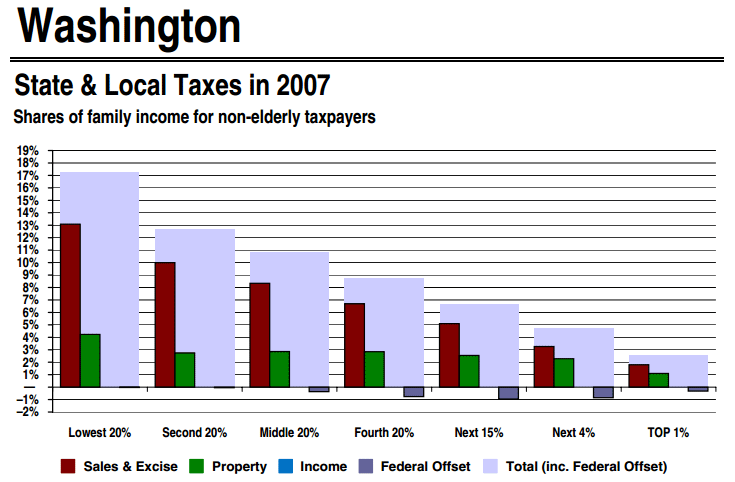
Why the imbalance? Because we exempt services from the sales tax, poor residents who buy more retail goods (diapers, clothes, etc.) and fewer services are effectively subsidizing more wealthy residents who spend their money on stockbrokers, attorneys and elective plastic surgery(opens in new tab).
If the sales tax covered both goods and services, the overall rate could be lowered; while an imbalance would still exist, it would not be as extreme. To truly create a more fair and equitable tax structure, Washington’s legislature needs to end special tax exemptions(opens in new tab) and enact a tax on high-incomes(opens in new tab).