Since the Great Recession began in 2008, more than $5 billion has been cut from Washington’s budget — and current forecasts show another $3 billion shortfall in tax receipts. The cuts have been particularly devastating to public education and health.
Among the cuts: $479 million in voter-approved student achievement funding disappeared when tax revenues bottomed out, and $236 million for the Basic Health Plan, which subsidizes low-cost health plans for low-income working adults.
Okay, so those are big numbers. But what do they mean specifically for Washington residents?
For education, it means the average annual per-student allocation for student achievement will drop from $458 in 2008-09 to $0 in the coming year (click graph to enlarge):

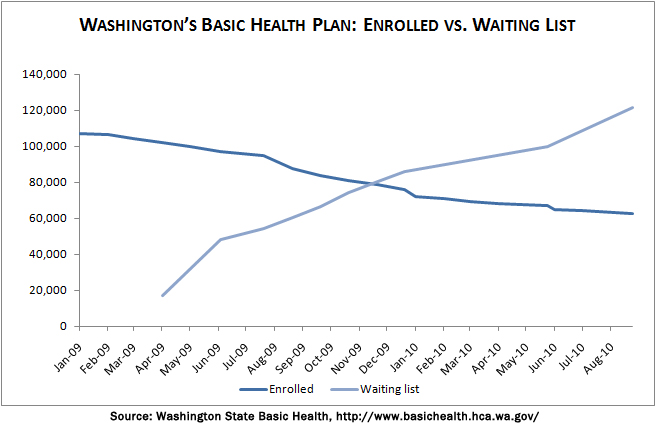
For health care, it means more than 40,000 working adults have lost low-cost basic health insurance, while many of those remaining on the Basic Health Plan have higher premiums (click graph to enlarge):
This fall, Initiative 1098 offers Washington voters an opportunity to reform Washington’s taxes and help restore the state’s health and education systems. If passed by voters, $1.6 billion dollars in revenue would be dedicated to educating Washington children, and $685 million toward the health of working Washingtonians.
It will also position Washington’s people and businesses to compete in the global economy as we emerge from the recession, by providing $650 million in tax cuts that primarily benefit middle class families and small businesses. That money will be pumped right back into the local economy — stimulus and investment Washington state needs to get our economy moving again.
Looking for more information about Initiative 1098? Visit the Economic Opportunity Institute website.
- Leave a Reply
More To Read
August 10, 2026
Buy, Borrow, Die: How tax codes gut community well-being to line pockets of the wealthy
We are long overdue for a tax code that requires the ultra-wealthy to pay what they owe.
July 30, 2026
What the Millionaires Tax would mean for Washington
We’re not paying the benefits of economic growth forward like we used to. The Millionaires Tax can change that.
July 9, 2026
How will the Millionaires Tax impact us?
The Millionaires Tax adds critical revenue to our state budget and starts to rebalance our upside-down tax code.